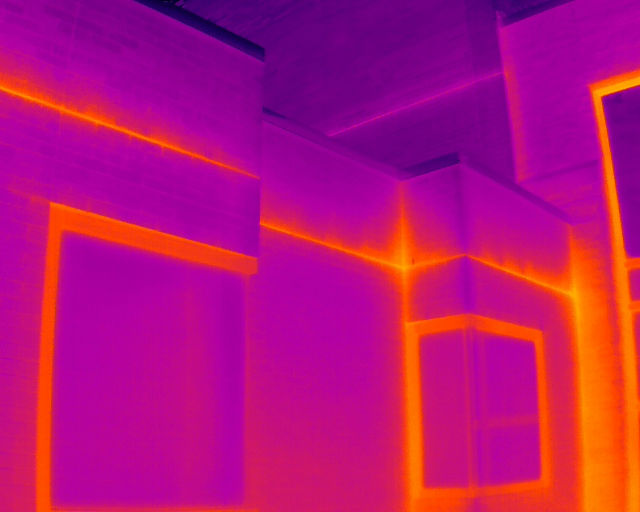
Why Your Thermal Roof Scan Has to Happen After Dark

Updated: Aug 20
Every facility manager asks the same question when we schedule an 8 p.m. flight. The answer is physics, and it's the difference between a finding and a photograph.

What thermal is actually measuring
A thermal camera doesn't see heat. It sees the infrared radiation a surface emits, and infers temperature from it. That distinction sounds academic until you're standing on a roof at two in the afternoon looking at an image where everything is bright and nothing is a finding.
What we're hunting for on a commercial roof is thermal mass. Wet insulation holds heat differently than dry insulation. Trapped moisture has a higher heat capacity than the material around it — it takes longer to warm up and longer to cool down. That lag is the entire signal.
Why daylight ruins it
During the day, the sun dumps energy onto the roof faster than any of these materials can differentiate themselves. Solar loading swamps the signal. A dark membrane in direct afternoon sun reads hot whether it's saturated or bone dry, and the thing you're trying to find disappears into the noise.
This is where a lot of cheap thermal work goes wrong. The image looks dramatic — lots of orange, lots of contrast — and it means nothing. A dark patch of ponded water reads hot in daylight and cool after dark: opposite conclusions from the same roof, four hours apart. HVAC exhaust, a rooftop unit, and afternoon sun on a parapet all produce warm signatures with nothing behind them.
The window, and why it's short
After sunset, the roof sheds the day's heat. Dry insulation gives it up quickly. Wet insulation — holding more energy, releasing it slower — stays warmer than its surroundings, and that delta becomes visible. The window typically opens an hour or two after sunset and lasts several hours, until everything equalizes. Wind, cloud cover, and recent rain all compress it. This is why Part 107 night authorization isn't a nice-to-have on this service. It's the whole service.
What this means for scheduling
If you're comparing thermal quotes and one of them proposes a mid-day flight, that's not a scheduling convenience. That's a firm that either doesn't know the physics or is betting you don't.
Common questions
Can you fly thermal during the day if scheduling is tight?
No. Daytime solar loading swamps the signal — a mid-day scan looks dramatic and settles nothing. The finding only separates out after the roof has shed the day's heat.
How long after sunset is the usable window?
Roughly one to two hours after sunset, lasting several hours until everything equalizes. Wind, cloud cover, and recent rain shorten it.
Does flying at night require special authorization?
Yes — Part 107 night-operations authorization, which is current here. Night flying is part of how this service is done, not an add-on.
Next step
Have a commercial roof and a question about it? That's exactly what a Level II thermal inspection is for — see what it covers and what it costs. The first call is free, and if a flight won't tell you anything a phone call can't, we'll say so. Weighing a storm claim? Here's what thermal can and can't settle.
About the author

Earl Bakke is a Level II Certified Thermographer and FAA Part 107 pilot with night-operations authorization. Twenty years in law enforcement and crash reconstruction, 450+ thermal inspections, and testimony in criminal and civil proceedings. He founded ScenePhoto360 in Stillwater, Minnesota. Read the full background.