
What Your Flat Roof’s Covering Means for a Thermal Inspection

Updated: 5 days ago
A thermal roof inspection is not a “point the camera at it and find the leak” service. The roof covering, construction, weather history, and inspection timing determine whether the imagery is meaningful—or whether it produces misleading anomalies and false confidence.
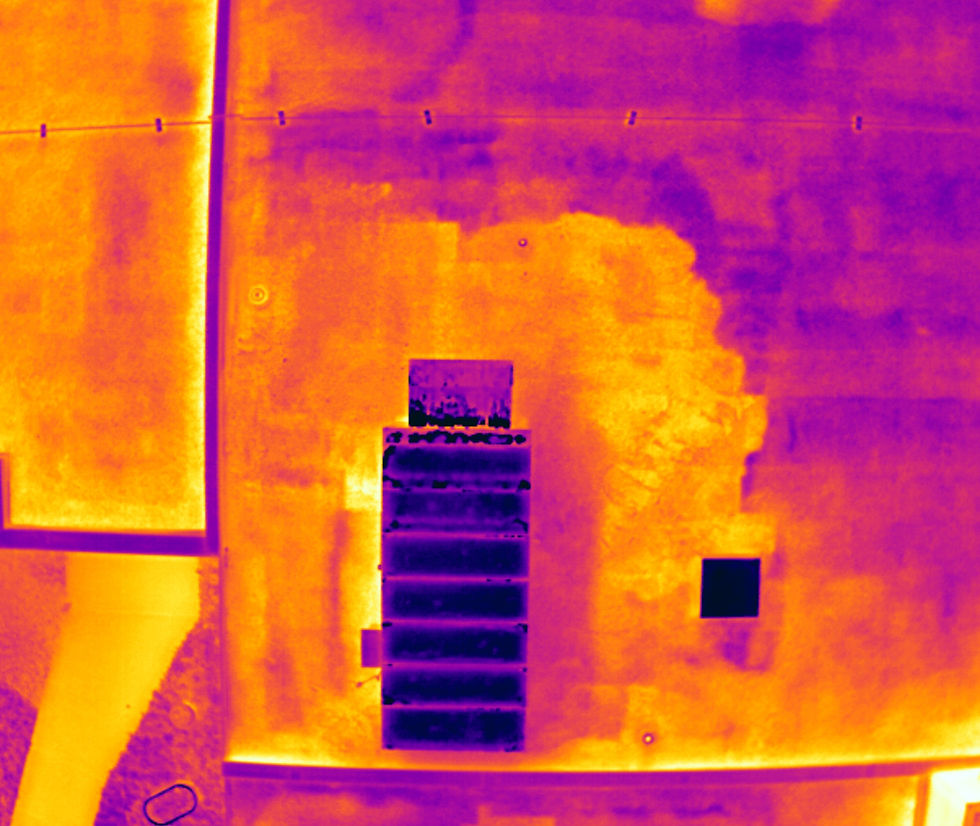
The governing principle is simple: a thermal camera measures infrared radiation emitted or reflected at the surface it sees. It does not see through a roof membrane, stone ballast, insulation, or deck. A roof moisture survey is an interpretation of surface-temperature patterns caused by the thermal behavior of the roof assembly—not an X-ray of what is beneath it.
What thermal roofing scans really detect.
In a conventional low-slope roof system, moisture trapped in insulation may store and release heat differently from surrounding dry materials. Under the right conditions, that difference can become visible as a thermal anomaly.
For a typical warm-weather survey, the roof needs adequate daytime solar loading, then the inspection is commonly performed during the evening cool-down period. The objective is to find patterns consistent with wet insulation, not simply “hot” or “cold” locations. Equipment exhaust, ponded water, repaired areas, membrane seams, shading, changing insulation thickness, and reflected sky or building temperatures can all create anomalies that are unrelated to moisture.
A defensible survey therefore includes thermal imagery, visual inspection, roof-plan documentation, an understanding of the roof assembly, and targeted verification where appropriate. Thermal imaging identifies areas of interest; it does not independently prove the presence, depth, or extent of moisture.
How common roof coverings affect results
Roof covering | Thermal-survey potential | Main limitations | Practical takeaway |
EPDM | Often a workable candidate when the membrane is exposed, dry, and properly solar-loaded | Dark EPDM can absorb solar energy well, but its surface characteristics and roof assembly still govern the result. Some non-invasive moisture meters can produce misleading readings on EPDM because of its carbon content, so confirmation method matters | Thermal imaging can be useful, but anomalous areas should be verified with an appropriate method rather than assumed to be wet. |
TPO | Potentially suitable, but highly dependent on color, reflectivity, exposure, and weather | White and reflective “cool roof” membranes may absorb too little solar energy and can reflect long-wave infrared from the sky, nearby structures, or the operator | A white TPO roof can produce false negatives and reflections. It is not an automatic “scanable roof” simply because it is a membrane roof. |
Large stone ballast | Generally a poor candidate for standard infrared moisture mapping | The camera sees the stone—not the membrane or insulation. Larger rock has substantial thermal mass and blocks a reliable expression of conditions below it | Do not accept a claim that a thermal camera can see through 1–1.5 inch rock ballast. Alternate methods, such as nuclear or capacitance approaches where appropriate, may be necessary. |
Small stone or pea-gravel ballast | Still difficult and inherently indirect | Smaller aggregate may allow some broad thermal response under favorable conditions, but each stone has its own temperature, shadowing, emissivity, and thermal mass. Resolution and interpretation are degraded | At best, treat results as a screening tool. Do not represent it as complete or equivalent to scanning an exposed membrane. |
EPDM: often workable, never automatic
EPDM is a common single-ply roofing membrane and can be a reasonable thermal-survey candidate when it is exposed, dry, uniformly heated, and installed over an assembly that permits moisture-related thermal differences to reach the surface.
But “EPDM” alone does not answer whether a thermal scan will work. The inspector should determine:
Whether the membrane is exposed or covered by ballast, pavers, coatings, or another layer.
The insulation type, thickness, number of insulation layers, and roof-deck construction.
Whether the roof has substantial shading from parapets, rooftop equipment, trees, adjacent buildings, or solar arrays.
Whether the membrane is dry at the time of inspection.
Whether the conditions support a meaningful heating or cooling cycle.
EPDM also illustrates why a competent inspection uses more than one instrument without blindly trusting any one of them. Some non-invasive capacitance meters can register EPDM as wet because of the membrane’s high carbon content; where confirmation is required, a suitable verification approach is essential.
TPO: white does not mean easy
TPO roofs—particularly white or highly reflective systems—can be substantially more challenging than people expect. Reflective membranes are designed to reject solar energy, which may reduce the solar loading needed to create a measurable wet-versus-dry thermal response.
Reflective surfaces can also complicate the camera’s view. A long-wave infrared camera may record reflected radiation from the cold sky, a warm wall, nearby mechanical equipment, trees, or other surroundings. That means an apparent pattern may be a reflection rather than a condition within the roofing system.
This does not mean thermal imaging is useless on every TPO roof. It means the survey must be planned around the actual roof, the membrane’s reflectivity, uniformity of exposure, expected thermal cycle, and alternate verification strategy. A technician who promises full diagnostic certainty on every white membrane roof without discussing these constraints is overselling the method.

Ballast stone: the camera sees the rocks
Stone ballast changes the problem completely. Thermal imaging records the exposed surface temperature of the ballast—not the temperature of the membrane buried beneath it and certainly not a direct image of moisture in insulation below.
With larger ballast, the stones physically obscure the roof surface and introduce their own thermal mass. The result is a highly variable field of individual rock temperatures, shadows, orientations, and solar exposures. A moisture-related pattern below the membrane may not transfer to the stone surface in a reliable, interpretable way.
Industry guidance is clear that infrared cameras cannot see through rock ballast, and roofs with approximately 1–1.5 inch ballast are typically candidates for another method, such as nuclear testing. Heavily ballasted roofs are also widely identified as incompatible or poor candidates for most infrared moisture-survey methods.
Small pea gravel may occasionally allow an experienced thermographer to identify broad, indirect areas of concern under highly favorable conditions. That is not the same as a reliable, 100-percent moisture map. The more covering, mass, and surface variability between the camera and the membrane, the less direct and less certain the thermal interpretation becomes.
Weather is part of the instrument
Weather is not a footnote in roof thermography. It is part of the test method.
For a solar-loaded warm-weather inspection, the roof typically needs:
A sufficiently sunny period to heat the assembly.
A dry membrane surface.
Low wind, because wind-driven convective cooling can erase or distort surface-temperature differences.
Minimal cloud cover during the needed heating or cooling phase.
Limited shading across the areas being evaluated.
Proper timing, often after sunset as the roof cools, when wet and dry materials may separate thermally.
Recent rain, dew, surface moisture, intermittent clouds, substantial shade, or high wind can make a scan unreliable. On a cool roof, lack of solar absorption may prevent useful thermal contrast altogether. In cold-weather approaches, the survey instead depends on a meaningful interior-to-exterior temperature differential and an assembly suitable for that method.
Questions to ask before buying a scan
A qualified provider should welcome these questions:
What is the exact roof assembly: membrane, color, ballast, insulation, deck, and number of layers?
Is the membrane exposed, or is it hidden beneath stone, pavers, vegetation, or an inverted assembly?
What weather criteria must be met before the survey proceeds?
What is the planned inspection window, and why?
How will shading, ponding water, rooftop equipment, and reflective surfaces be handled?
Are you proposing a screening survey, or are you claiming a moisture map with verification?
What method will confirm thermal anomalies: test cuts, calibrated moisture testing, nuclear survey, capacitance testing, or another appropriate technique?
Will the deliverable identify limitations, excluded areas, weather conditions, thermal images, visual images, and the basis for each finding?
The right answer is sometimes: thermal imaging is not the best primary method for this roof. That is not a failure of the technology. It is competent method selection.
The bottom line
Thermal imaging is a powerful roof-assessment tool when the roof assembly and environmental conditions support it. It is not a camera that sees through materials, and it should never be marketed that way.
An exposed, properly solar-loaded membrane roof may be a strong candidate. A reflective TPO roof may demand careful timing and cautious interpretation. A heavily ballasted roof may require an entirely different moisture-survey method. Before approving a thermal scan, make sure the provider understands not only how to operate the camera, but also what the camera is actually capable of seeing.
NEXT STEP -
Questions? Let’s Talk.
Before paying for a thermal roof scan, make sure your roof is actually a good candidate. Call ScenePhoto360 to discuss your roof type, covering, conditions, and inspection goals—and get the right assessment method from the start. Also, read the thermal website page for more information.
About the author

Earl Bakke is a Level II Certified Thermographer and FAA Part 107 pilot with night-operations authorization. Twenty years in law enforcement and crash reconstruction, 450+ thermal inspections, and testimony in criminal and civil proceedings. He founded ScenePhoto360 in Stillwater, Minnesota. Read the full background.


