
Can You Scan a Flat Roof or Building Façade using Thermal Imaging During a Twin Cities Winter?

If you manage commercial or multifamily property in the Twin Cities, the answer is yes — with the right conditions. Flat-roof scans depend on sufficient solar loading to help reveal patterns associated with possible trapped moisture. Building-facade scans benefit from the temperature difference between a heated interior and the cold outdoors. Winter can provide valuable inspection opportunities for thermal imaging, but the timing and approach depend on what we’re investigating.

What we're actually looking for
On a flat roof, the goal isn’t a dramatic picture — it’s identifying thermal patterns that may indicate moisture within the roof assembly. Wet insulation stores and releases heat differently than dry insulation. Under suitable conditions, those differences help identify areas for follow-up testing, so repair decisions start with evidence rather than a guess. A thermal anomaly alone does not confirm moisture or pinpoint where water entered the roof.
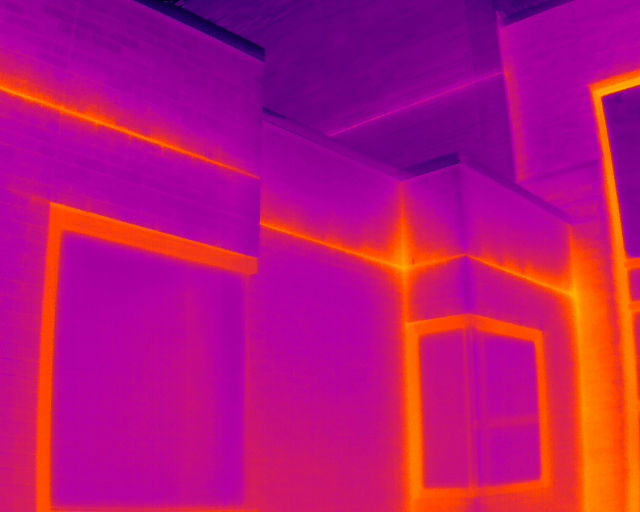
On a building facade, the question changes: where is heat escaping, and what might explain the pattern? Thermal imaging can reveal signatures consistent with missing or uneven insulation, thermal bridging, and air leakage. For engineers and property representatives, those patterns help focus further investigation on specific wall areas, window perimeters, and building-envelope transitions.
Why timing is different for roofs and facades
For a solar-loaded roof-moisture scan, sunshine does the preparation and the after-dark cooling period creates the inspection opportunity. As the roof cools, moisture-affected insulation may remain warmer than surrounding dry areas. A strong day of winter sunshine can help establish that contrast, but the roof assembly, surface conditions, and weather determine whether the signal will be useful. There’s a full explanation of the after-dark window if you want the detail.
For facades, the useful temperature difference is primarily between the heated interior and the cold outdoors. That difference — called Delta-T — drives heat through the building envelope and helps reveal variations in thermal performance. Winter can provide excellent conditions for this work. Direct sunlight can complicate the picture, so exterior scans are generally scheduled when solar effects have dissipated, often overnight or before sunrise.
How the local climate shapes timing
Minnesota winter is an opportunity for facade inspections, but it is not an automatic green light for roof-moisture surveys. A sunny forecast alone is not enough. Snow cover, surface moisture, wind, and the roof’s construction can prevent a meaningful inspection. A snow-covered roof is not the same inspection opportunity as a dry, exposed roof that has absorbed a full day of sunshine. We evaluate the actual conditions rather than promise that every roof can be scanned year-round.
For heated buildings, cold weather can make facade heat-loss patterns easier to distinguish. Low wind, dry surfaces, stable indoor heating, and limited solar influence help produce more interpretable results. A large Delta-T is useful, but it does not eliminate the need to account for building materials, reflections, and other influences on surface temperature.
The process, start to finish
It starts with a short scoping call: are we investigating possible roof moisture, facade heat loss, or both? We review the building, the areas of concern, and the conditions needed to answer that question. Capture timing follows the inspection objective — not simply the next available flight slot.
For commercial and multifamily buildings three stories or taller, there’s another practical advantage: documenting upper-level facades without sending an inspection crew up the side of the building for the initial imaging survey. Drone-based thermal and visual imaging can capture hard-to-reach areas while the flight crew remains on the ground, reducing the need for work at height during that phase of the investigation.
That can also mean substantial savings when the alternative involves renting lifts, erecting scaffolding, or arranging specialized rope-access crews. Aerial imaging can help owners and engineers identify where closer examination is warranted before committing to extensive access arrangements. Hands-on testing and repairs may still require physical access — the goal is to make that access more targeted, not claim it will never be necessary.
The work includes Level II interpretation and a signed report — not just raw imagery. Findings are documented with their locations, inspection conditions, and limitations so they can support informed follow-up. Suspected roof moisture may require moisture measurements or core sampling before repair decisions are finalized. We work throughout the Minneapolis–St. Paul metro and surrounding region; see our full service areas.
Common questions
Can a flat roof be scanned when it's cold outside?
Sometimes. Strong solar loading can create useful thermal contrast, but cold-weather suitability depends on the roof assembly and actual site conditions. Snow, surface moisture, and unfavorable weather can prevent a useful scan even after a sunny day. We assess those conditions before deciding whether a flight can produce meaningful findings.
Is winter a good time to scan a building facade?
Yes — particularly when the building is heated. The indoor-to-outdoor temperature difference can make patterns associated with heat loss, insulation deficiencies, and thermal bridging easier to distinguish. The best inspection window also limits wind, precipitation, and direct solar effects.
What is the benefit for buildings three stories or taller?
Aerial imaging helps document upper-level walls and other areas that are difficult to inspect from the ground. It can reduce the need for lifts, scaffolding, or rope access during the initial survey, lowering exposure to work-at-height hazards and potentially reducing access costs and disruption around an occupied property. Follow-up testing may still require a closer, hands-on inspection.
Does a warm area mean there is definitely a problem?
No. A warm roof area does not automatically mean wet insulation, and a warm facade area does not automatically mean a construction defect. Materials, thermal bridges, mechanical equipment, solar exposure, and reflections can influence the image. Interpretation and appropriate verification turn a temperature pattern into useful building information.
What areas do you cover?
The Minneapolis–St. Paul metro and surrounding region — including Stillwater, Rochester, Duluth, and western Wisconsin — with travel for larger commercial and infrastructure projects.
Next step
If you manage commercial property in the metro and want the roof read properly, start here. See thermal imaging, or read what a Level II thermographer interprets.
About the author

Earl Bakke is a Level II Certified Thermographer and FAA Part 107 pilot with night-operations authorization. Twenty years in law enforcement and crash reconstruction, 450+ thermal inspections, and testimony in criminal and civil proceedings. He founded ScenePhoto360 in Stillwater, Minnesota. Read the full background.


